
How a New Eagle Site Opens: What Local Coverage Really Means
Fast answer: a new Eagle site does not open with a single landing page and a hope. It opens the way the Maryland sites were built — a full local site, a page for every service in every covered city, a local way to reach the crew, and dispatch behind it from day one. That is what happened most recently in New York, and before that in South Carolina and Minnesota. If a site carries your city, it means a crew is set up to serve that city — not that an ad was pointed at it.
Why the network expands state by state
Home services are local work. A locksmith in New York City deals with building access, co-op rules and street parking that a locksmith in Maryland never sees. A chimney crew in Minnesota works through a longer, colder heating season than a crew in South Carolina, where the season is shorter and storm damage matters more. Keeping each state on its own site lets the pages, the scheduling and the crews reflect those differences instead of pretending one national script fits everywhere.
It also keeps the promise honest. As we explained in how the network works, Eagle is a family of dedicated trade brands, not one generalist company. A new state site is a new local branch of one of those brands — same trade, same standard, new territory.
Newest first: New York locksmith and garage door
New York is the newest opening, and it came in two trades at once. The New York locksmith site covers New York City and Long Island, with pages for lockouts, rekeying, lock changes and car keys organized by neighborhood and town. Alongside it, the New York garage door site covers garage door repair, springs, openers and new doors for the same metro area.
Opening two trades together is deliberate. A broken garage door and a lock that will not latch are often the same house, the same week, and the same worried homeowner. When both local sites feed the same dispatch board, a call about one problem can be routed correctly if it turns out to be the other — without the homeowner starting the search over.
Before New York: South Carolina chimney and Minnesota chimney
The pattern was set by the chimney expansion. In South Carolina, the Eagle Chimney SC site brought sweep, inspection, repair and masonry work to the Myrtle Beach area and beyond, built city by city for South Carolina homes. In Minnesota, the Eagle Chimney MN site did the same for a state where a fireplace is not a decoration — it is a working heat source for much of the year.
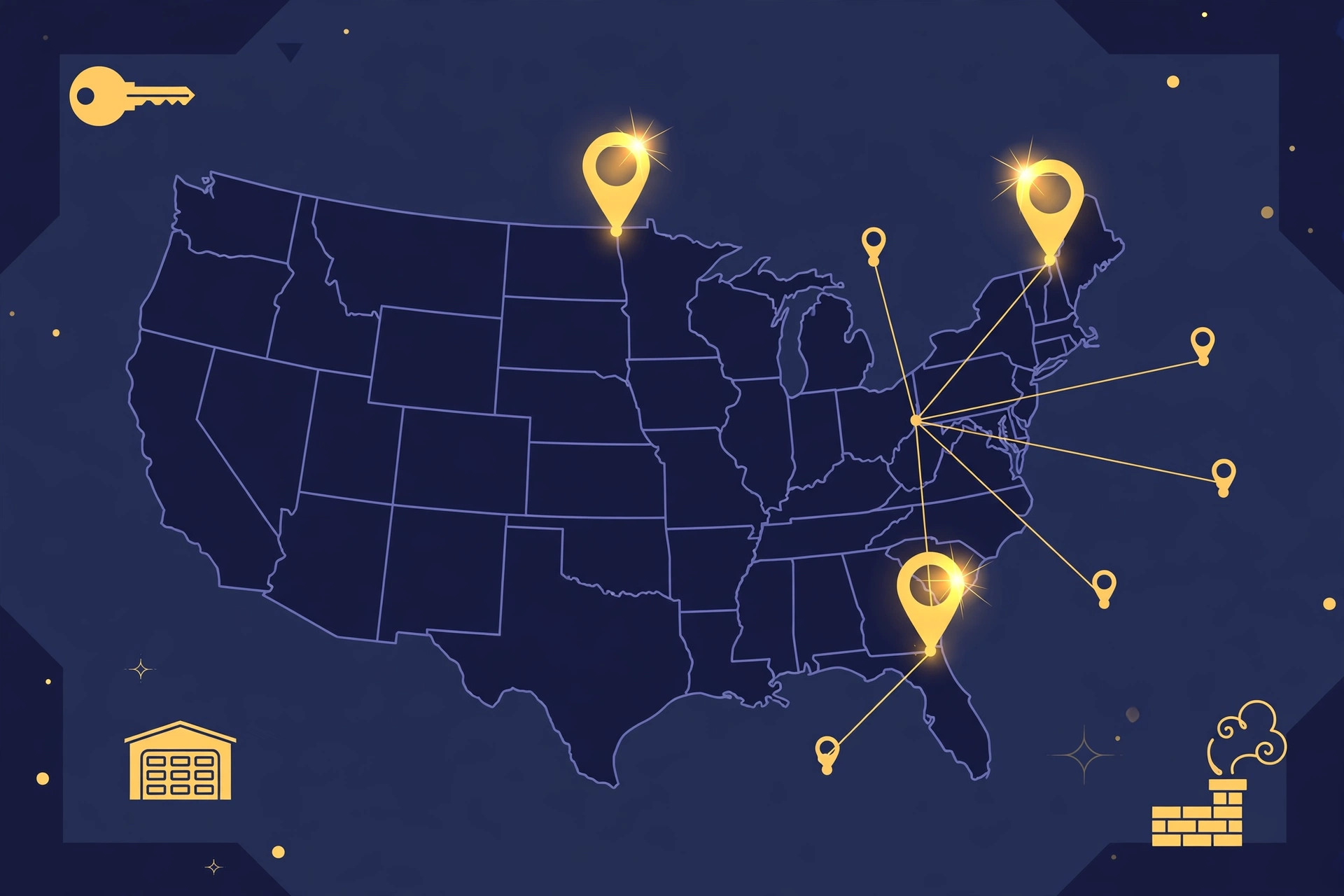
Those two openings show why local coverage matters more than a pin on a map. The questions a South Carolina homeowner asks before hurricane season are not the questions a Minnesota homeowner asks in October. Separate sites let each answer live where the homeowner will actually look for it, in the language of that place and that season.
What gets built before a site goes live
- A page for every service in every covered city. Not one page that lists towns in a footer — a real page about that service in that city, written before the first customer searches for it.
- A clear way to reach the local crew. The site names the trade, the area and how booking works, and every request lands on the shared dispatch board.
- The finder connection. The new site is added to the network finder, so a ZIP search on our home page routes to it instead of to a neighboring state.
- The same closing standard. Regular hours are Sunday through Friday, closed Saturday, with phone answering 24/7 — the same pattern a Maryland customer already knows.
Only when those pieces are in place does the site join the 45 sites listed on our home page. If you do not see your state yet, that usually means the build is not finished — not that a crew will drive in from three states away and pretend to be local.
What local coverage means when you call
For a homeowner, the practical test is simple. Use the network finder and enter your ZIP, state and trade. If a site comes up, it covers you: the crew, the service pages and the scheduling are set up for your area. You can call the network number, (855) 640-0404, or go straight to the local site and book there — both reach the same dispatch board.
Local coverage also means clearer expectations before anyone arrives. The local site carries that trade's published starting prices for its area — for example, our guide to what common jobs cost explains how starting prices work and what drives a final quote. You are not guessing from another state's price list.
What does not change when a new state opens
The backbone stays the same. One dispatch system tracks the job from first call to completion, calls are answered around the clock, and a problem that crosses trades can be handed off inside the network. The Maryland home base — sites like the Maryland chimney site and the Maryland garage door site — keeps running the same way it did before the expansion. Growth adds local sites; it does not dilute the standard the older sites set.
How to check whether you are covered
Start with the finder, not a search engine guess. Go to the finder on our home page, pick your state and the trade you need, and follow the result to your local site. Read the service page for your city, check the details there, and book or call from that page. If your area is not listed yet, call (855) 640-0404 anyway — dispatch can tell you plainly whether the network covers you today or when it is expected to, instead of leaving you with a vague promise.
A new state opening is not a press release. It is a site you can read, a city page you can find, and a crew you can book. That is the standard New York, South Carolina and Minnesota were built to — and it is the standard the next state will be held to as well.
Need a pro now? One number reaches every Eagle trade — or use the finder on our home page and go straight to the site that covers your ZIP.
Call (855) 640-0404